


Project Enlightenment · Overview
Project Enlightenment · Prologue
A Summary of World History
How language, seed grain, and chance became the system we live in today.
Listen (read by Mira)
“Present-day system” here means the web we live inside: nation-states + global capitalism + scientific-technological civilization + international institutions.
I
The Great Thresholds
The reliable record begins not with writing but before it: at the point where the evidence becomes solid enough to stand on.
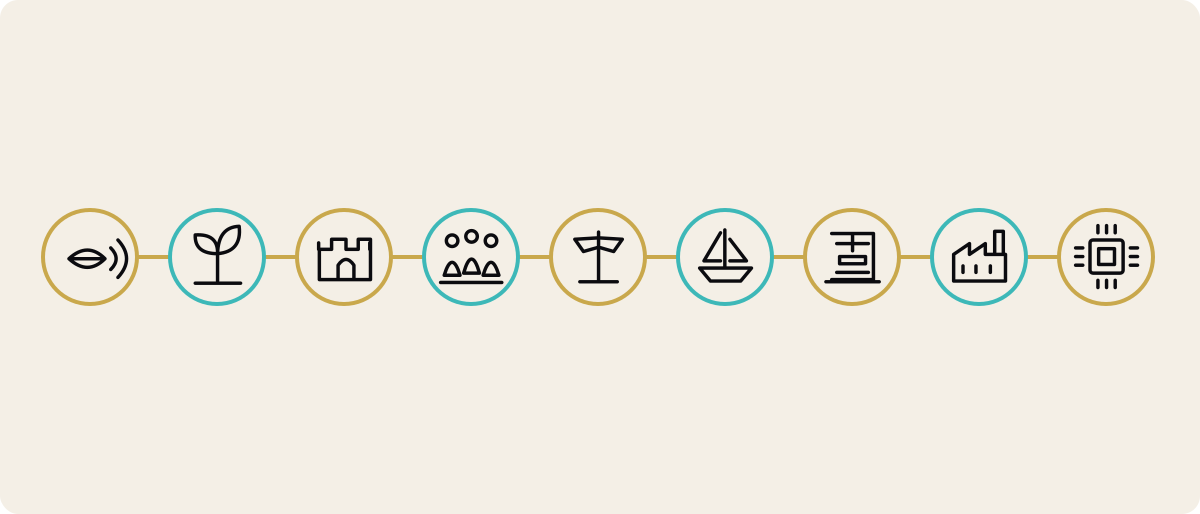
Cognitive Threshold · ~70,000 BC
The Language That Invents Realities
Homo sapiens develops language beyond the concrete: myths, rules, shared fictions. This allows cooperation among strangers in large numbers: the species' true superpower.
Neolithic Revolution · ~10,000 BC
Settlement & Surplus
Agriculture and domestication. Surplus → stockpiles → property, hierarchy, specialization. Here the basic equation of all power emerges: whoever controls the surplus controls the people.
First Civilizations · ~3500 BC
City, State, Taxes, Writing
Mesopotamia, Egypt, the Indus, the Yellow River. Writing emerges first for bookkeeping, not for poetry. “History” in the narrow sense begins.
Axial Age · ~800–200 BC
Universal Ideas of Order
Almost simultaneously in Greece, Israel, Persia, India, China: philosophy and world religions place the individual before something universal, instead of merely before local gods.
Ancient Empires · ~500 BC–500 AD
Administration at Scale
Persia, Rome, Han China, the Maurya. The invention of law, infrastructure, money, and bureaucracy on a grand scale.
Post-Classical Interconnection · 600–1400
Silk Road & Indian Ocean
Islam as a bridge; knowledge, goods, and diseases circulate. The Mongol Empire (13th century) links Eurasia end to end for the first time.
Globalization 1.0 · ~1500
The Columbian Exchange
“Discoveries,” the exchange of plants, animals, plagues, people, silver. For the first time a truly planetary system, carried by violence, slavery, colonialism.
Scientific Revolution · 16th–17th century
Method Instead of Authority
Experiment and mathematization. Knowledge becomes cumulative and testable, no longer derived from authority.
Enlightenment & Revolutions · 1776 / 1789
Sovereignty Migrates to “the People”
In theory: power passes from the ruler to the people. Rights, constitution, nation.
Industrial Revolution · ~1760–1900
The Real Rupture
Fossil energy replaces muscle and wood power. For the first time, growth decouples permanently from population. Per-capita prosperity explodes.
20th Century · 1914–1991
Collapse & Reordering
Two world wars, mass ideologies, then Bretton Woods, the UN, decolonization, the Cold War. Out of this, today's framework crystallizes.
Digital Globalization · from ~1990
Information Becomes (Almost) Free
Knowledge becomes practically free to copy and transmit. This is the threshold we are standing on right now.
II
The Theories: What Drives History?
The great schools contradict one another. Each explains something; none explains everything.
Marx
Materialism
Mode of production and class struggle drive everything; ideas are mere “superstructure.”
Strong:industrialization, capitalism
Weak:why the same material conditions take entirely different paths
Hegel, Weber
Idealism
Ideas, religion, culture do the driving: Weber's “Protestant ethic” as the spark of capitalism, for instance.
Strong:explaining motivation
Weak:overrates single causal chains
Jared Diamond
Geographic Determinism
Climate, species, and continental axes decide who gets surplus and immunity early.
Strong:the very long run
Weak:the last 500 years (too deterministic)
Acemoglu & Robinson
Institutionalism
“Inclusive” vs. “extractive” institutions decide prosperity.
Strong:the modern era
Weak:where institutions come from
Wallerstein
World-Systems Theory
A capitalist core–periphery system in place since ~1500 explains global inequality.
Strong:colonialism
Weak:underrates the periphery's own dynamics
Ibn Khaldun, Spengler, Toynbee
Cyclical Models
Cultures and empires pass through birth, flowering, decay.
Strong:the rise & fall of empires
Weak:doesn't explain modernity's directed growth
Carlyle et al.
Contingency / “Great Man”
Chance and individual people tip history at its turning points.
Strong:individual turning points
Weak:as a total explanation
III
Crystallized: The Most Probable Line
No school is right on its own. Together they yield a multi-stage feedback model.
Geography sets the starting conditions → surplus generates complexity (state, writing, hierarchy) → institutions and ideas channel that surplus → energy + knowledge feed back and accelerate → chance decides who passes through the next gate first.
Nature distributed domesticable species and climate unevenly (Diamond). That gave Eurasia a head start, not any moral or biological superiority. Wherever surplus arose, state, writing, and classes followed inevitably; here materialism is right.
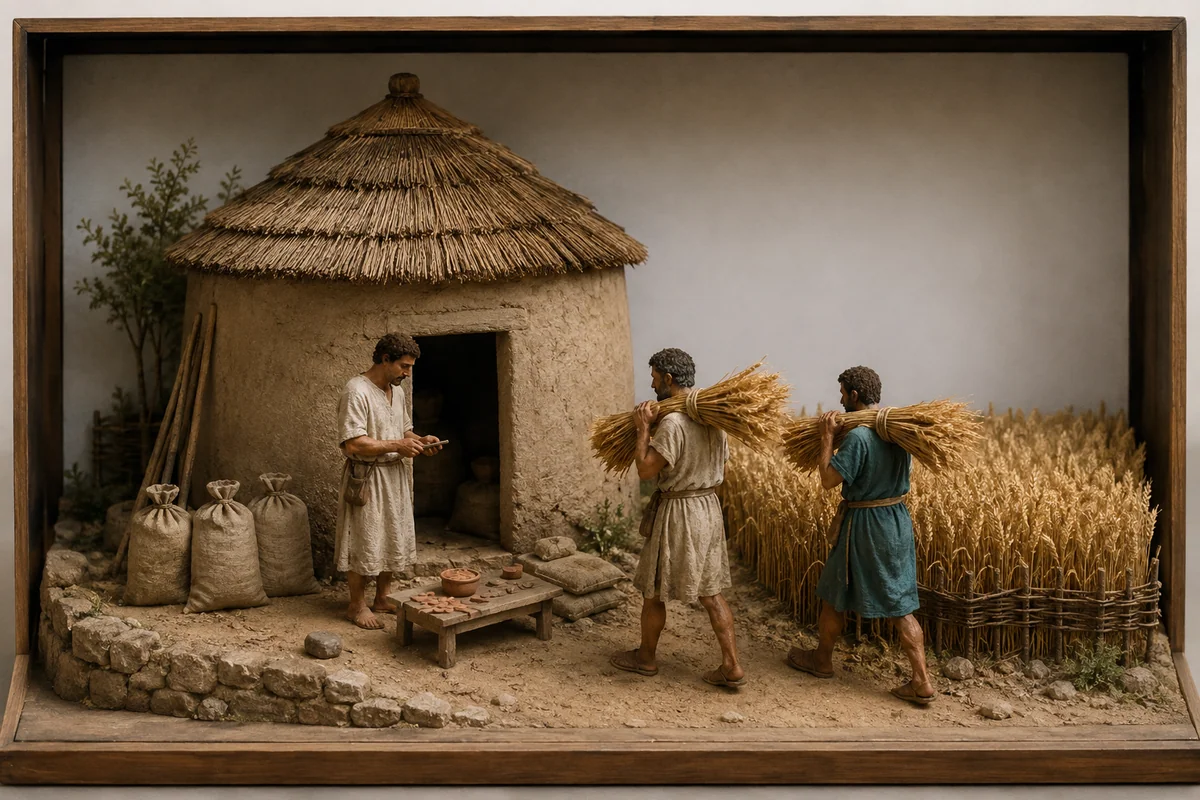
But what form this took was decided by ideas and institutions (Weber, Acemoglu), which is why the same material conditions led to pharaoh, polis, or mandarinate.
For millennia everything stayed inside the Malthusian trap: more productivity → more people → poverty again. The decisive rupture was not a single idea but fossil energy + cumulative science + competing states + capital from global trade and colonialism, all converging in Europe at the same time. That broke the trap for good, and ever since, prosperity has grown faster than population.
Today's system is the consequence: the industrial rupture produced such differences in power and wealth that the leading industrial nations dominated the rest of the world for roughly a century and a half. In the 20th century that order collapsed in two world wars, and out of the rubble a new framework was deliberately built: nation-states as the standard form, embedded in international institutions (the UN, Bretton Woods, the world trade regime), carried by global capitalism and by a cumulative, self-accelerating science.
Since ~1990 the digital layer has been running on top of it all: information becomes nearly free, which is once again rebuilding markets, power, and the public sphere. The next threshold moment, its outcome still open. The lesson of the long line: history is neither pure chance nor pure fate, but a chain of thresholds at which material conditions stake out what is possible, ideas shape what becomes concrete, and chance decides the order.
✦
Further Sources
One entry point per position: the books that made each thesis famous, plus data and key terms to look up.
The Great Explanatory Books
- Yuval N. Harari: Sapiens.: The cognitive threshold & shared fictions. ↗
- Jared Diamond: Guns, Germs & Steel.: Geographic determinism. ↗
- Acemoglu & Robinson: Why Nations Fail.: Institutionalism. ↗
- Max Weber: The Protestant Ethic.: Ideas as a driving force. ↗
- Immanuel Wallerstein: World-Systems Theory.: Core & periphery. ↗
- Ibn Khaldun: Muqaddimah.: The earliest cyclical model of history. ↗
- Kenneth Pomeranz: The Great Divergence.: Why Europe pulled ahead from 1800. ↗
Key Terms to Look Up
- Neolithic Revolution: agriculture, settlement, surplus. ↗
- Axial Age: Karl Jaspers’ thesis of a simultaneous revolution of the mind. ↗
- Columbian Exchange: the beginning of the planetary system. ↗
- Scientific Revolution: method instead of authority. ↗
- Industrial Revolution: the real rupture. ↗
- Bretton Woods system: the economic scaffolding of the post-war order. ↗
- Malthusian trap: why gains in prosperity never lasted before 1800. ↗