



chazon · III / III · Vision
Chazon
Bridging opposing ideologies
Our global challenge may be to create a system that unites individual freedom and collective well-being: a balanced model for personal growth and shared responsibility.
Listen (read by Mira)

The search
The search for balance
Between freedom and community
Perhaps it is the real task of our time: to build a system in which individual freedom and the good of all no longer stand against each other. Not a distant utopia, more a craft that carries personal growth and shared responsibility in the same breath.
The old quarrel runs on an either-or. The vision begins with a different sentence: Individual success serves the community. Where people and companies work together instead of crowding each other out, the zero-sum game ends. That is the core of a system that does not divide but carries.
Two poles
Beyond the old camps
Two sides, one principle
Capitalism and communism each bring valuable ideas, yet their one-sided orientations (competition vs. equality) lead to imbalance. A new system may integrate the strengths of both to enable social justice, sustainable growth and individual well-being.
The individual pole
Individuality · Freedom · Innovation
Strength
Sparks innovation and prosperity. Rewards creativity, entrepreneurship and personal freedom. Private property and pursuit of profit as engine: wealth through competition.
Shadow
When profit maximization becomes the sole measure, the social divide deepens. Large corporations push out smaller ones and accumulate market power. Constant competition creates emotional pressure: burnout, depression, precarious employment.
The collective pole
Community · Equity · Solidarity
Strength
Strengthens social justice. Basic needs are carried: health, education, housing, food. Solidarity and a sense of community as the foundation.
Shadow
When the collective is placed above the individual, personal freedom, incentives for innovation and creative expression shrink. Central planning often leads to inefficiency, supply shortages and emotional estrangement.

The way
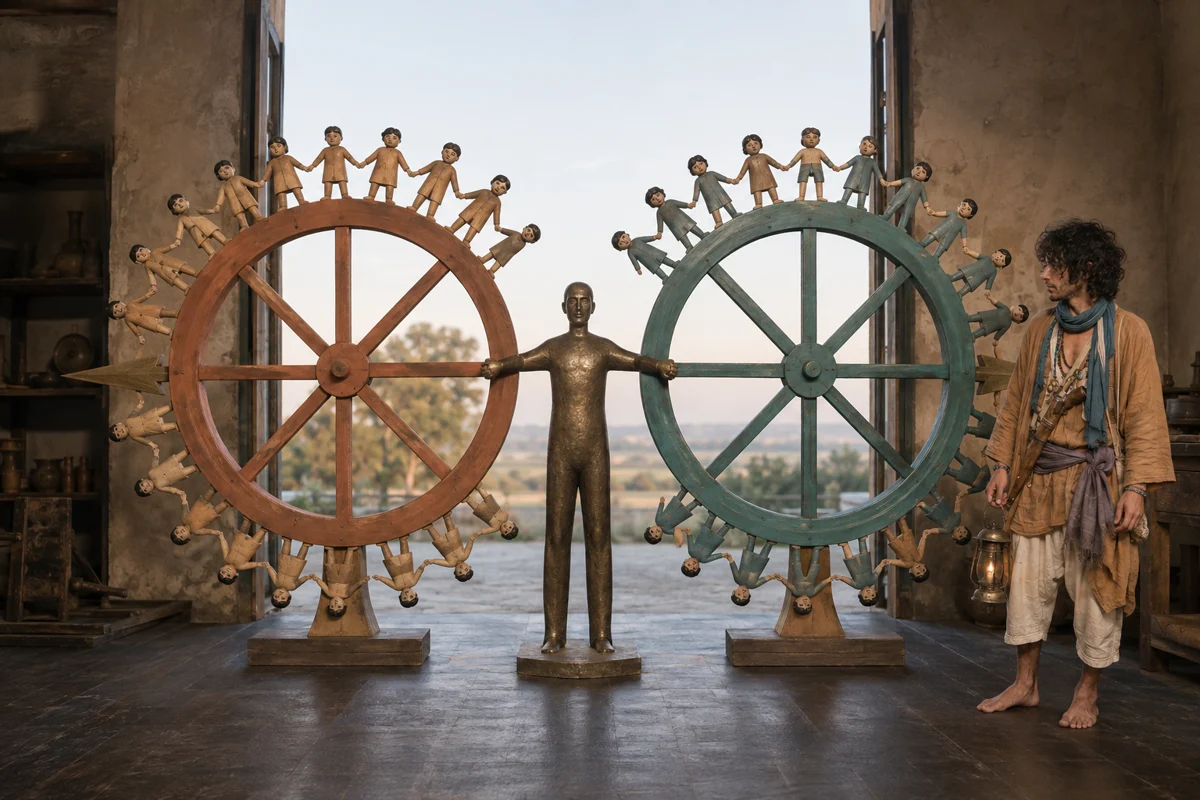
Balance of opposites
The best of both worlds
1928, an untidy laboratory, a mould on a forgotten dish. Alexander Fleming could have thrown it out. He looked closer, and around the mould the death of the bacteria was a clean, clear ring. That is how almost every rescue begins: with someone who does not throw the unremarkable away.
But the discovery alone saved no one. Only when the British and the Americans pooled their knowledge did the ring on the dish become a medicine for millions. Had one of them kept it, it would have stayed a footnote. Progress emerges when knowledge is shared, not when it is sold: when enterprise serves the common good, when everyone has basic security and room still remains for their own work. Security without stagnation. Freedom without displacement.

The path
Five steps to change
From awareness to transformation
Step by step, guided by clear values, not as upheaval, but as targeted adjustment that may benefit all in the long run.
-
Awareness and education
Strengthen awareness of the benefits of a balanced system. Educational programs in schools and universities that view economic and social topics holistically and foster balanced, harmonious thinking.
-
Social reforms
Reform the social system so all citizens receive basic provision. Democratize the labor market. Universal basic income as a safety net, accompanied by worker cooperatives with real voice.
-
Community projects & open data
Community-oriented research initiatives and cooperative companies receive tax breaks. Global projects in medicine and technology, like the Human Genome Project or COVID-19 vaccine development, as a model.
-
Global resource budget
A clearly defined measure of CO₂, water, land use per company. Those who work resource-efficiently receive support. Those who overuse pay offsetting fees. Digital systems make consumption transparent. Citizens can see how sustainably a company operates.
-
The common-good indicator
Alongside GDP, a common-good indicator measures contribution to environmental awareness, social justice, working conditions and ethical behavior. Companies with high common-good ratings receive more support.
The mechanics
What the proposal can be measured against
Two levers and a legal text
A vision no one can contradict has never convinced anyone. It sounds good and stays without consequence, because there is nothing it could fail at. So what stands here is what can be checked: two levers, with limits and clear responsibility, and one legal text word for word. The path before it names the direction. This chapter names the screws.
The resource budget
A fixed measure of CO₂, water and land for every company
- Those who stay within the budget and innovate ecologically gain access to support. Those who overuse lose rights or pay offsetting fees. The second sentence is the one a proposal leaves out when it wants to hurt no one.
- Measurement is digital, continuous and tamper-proof. Without measurement a budget is a declaration of intent, and declarations of intent cost nothing. The data therefore does not sit with whoever reports it.
- Anyone can inspect them: customers, neighbours, competitors, the press. Oversight no longer hangs on a single authority. In this accounting the earth is no longer an endless supply but a bounded habitat with a balance sheet.
Citizens' councils and codetermination
Who decides, when the top no longer decides alone
- Regional future councils advise the parliaments. They sit where the consequences of a decision arrive, and their recommendations enter the procedure, not an appendix.
- For climate policy, citizens' assemblies convene, seated by lot. Not the loudest, not the best connected, but a cross-section that is given time, expertise and a mandate. Research projects can be shaped along the same principle.
- In companies, employees have a vote in choosing the management. In cooperatives every voice counts equally, regardless of capital share. People are then no longer only those who consume, but those who shape.
Case study · Constitution
From here it becomes uncomfortably concrete. The example is the Constitution of the United States, not because it stands above other legal orders, but because its wording is read worldwide and every amendment to it can be followed in public. It stands here as a case study, not as a model. What shows itself in it holds for every constitution: it contains the instructions for its own amendment.
The Congress, whenever two thirds of both Houses shall deem it necessary, shall propose Amendments to this Constitution …
Article V, Constitution of the United States
The Fifth Amendment
It protects private property. No one may be deprived of it without due process of law, and where the state takes for public use, it owes just compensation. Of an obligation on the owner it says nothing.
No person shall be deprived of life, liberty, or property, without due process of law; nor shall private property be taken for public use, without just compensation. However, property rights carry with them the responsibility to shape their use so that it does not harm the public good or future generations – in particular with regard to the preservation of the environment.
Property entails obligations. Its use shall also serve the public good.
Article 14, paragraph 2, German Basic Law
What the proposal still hopes to achieve for the United States has had constitutional rank in Germany since 1949. At this point the utopia is not a utopia but a precedent that a society has lived with for over seventy years.
The original went further and wanted to place freedom of speech under an environmental proviso as well. That passage is not carried over here. A right that holds only as long as its exercise harms no one is no longer a right but a permission. The rest stands concretely enough to be wrong, and precisely there lies its strength: anyone who wants to object will find the chapter for it just below.
The call
Reach also those who profit strongly today
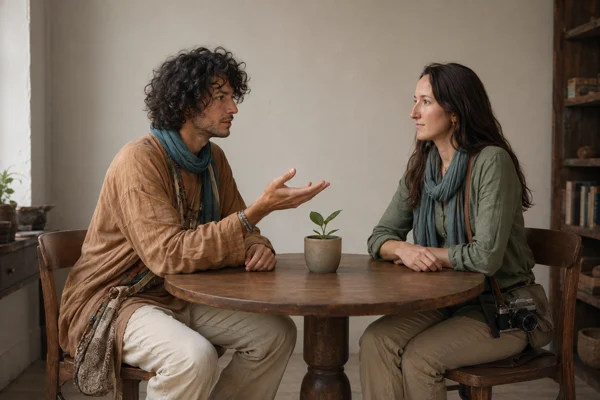
Through dialogue, not through battle
The hardest task is not to win over the convinced, but to reach those who live well in the old ways. Not through struggle, but through encounter. You need not start from zero: peace, security, stability are wished for by almost everyone, including those who profit today.
So show that it works. Linux and Wikipedia, carried by many hands. Mondragon, where the workforce is the owner. Citizens who make their own power. Change in small, bearable steps, voluntary first, so that no one feels overrun. It succeeds only when every voice appears and is heard. A system that unites the strengths of both poles opens, in the end, not only laws but hearts.
The objection
What you are thinking now
Six objections, and what can be said to them
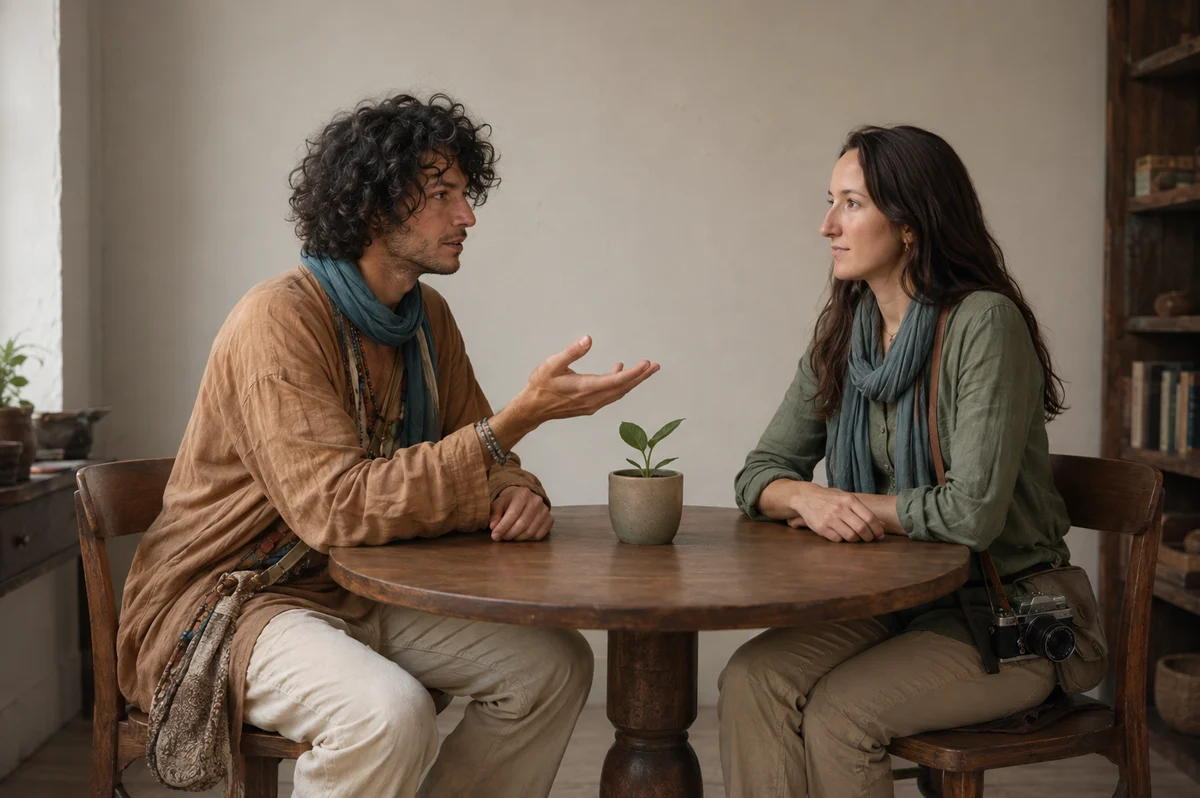
Anyone who has read this far has argued back along the way. That is not interference, that is the test the text needs. So the objections stand here as they actually sound, not in the tamer version that would be easier to answer.
Things are going fine. Why change anything?
The sentence is true, and that is exactly the difficulty. For many, things are indeed going well, and no one need apologise for it. But it is spoken from the inside, from a life where the sums add up. A few streets away the same sums do not, and the earth submits its bill later. This is not about overturning what works. It is that a system carrying only one part will, in time, stop carrying that part too.
If everyone gets the same, motivation disappears.
There is a mix-up here: basic security is a floor, not a ceiling. No one is proposing that everyone receive the same. What is proposed is that no one fall below it. Whatever grows above may keep growing, and effort may keep paying. Anyone who has worked under real fear of not making rent knows the rest: fear is a poor engine. It narrows people rather than making them inventive.
But competition drives progress!
Yes. The objection is not a counter-argument, it is half an argument. Competition drives, no one disputes that. Yet the largest leaps come strikingly often from the opposite: the human genome was decoded by researchers across several continents together. The software much of the internet runs on was never sold by anyone. And penicillin became a medicine only when two countries pooled what they knew. The question is not whether we compete. It is what we compete for.
That would burden the economy for nothing and raise taxes.
The costs are already here, they simply sit on a different invoice. Exhausted people, depleted soil, damage that someone settles later, usually the public and usually at a higher price. A common-good index demands no new authority, it makes visible what accrues anyway. And incentives are cheaper than repairs: it has never been cheaper to fix a harm than to keep it from arising.
Change is risky and could weaken our position.
True. So is doing nothing, it simply draws less attention. The status quo is no safe harbour but a risk with a later due date, and the bill goes to people who are not yet allowed a say. That is why five steps stand above and not an about-turn: small enough to be taken back, large enough for their effect to show.
This is just idealistic dreaming. It does not work in the real world.
It already works, only quietly. Mondragon in the Basque Country has belonged to the people who work there for over sixty years, and it feeds tens of thousands. Wikipedia outlived an entire industry without ever having sold anything. Citizens generating their own power are no longer a pilot scheme. This is not a vision, it is an operating condition, merely a little-known one. The dreaming would be to assume that what exists will stay as it is on its own.