
energies · VI / XX · Sphere B · Body & Field · All 20
You yawn when he yawns. That is research, not courtesy.
In your premotor cortex, neurons fire not only when you act, but also when you see someone else act. You live their inside inside your own.
Do you know the moment when you walk into a room and immediately know: there is tension here? No one has said anything. But your body has already read the field of the others. That is co-regulation in real time.
I · Structure · Measurable
Rizzolatti et al. 1996 discovered mirror neurons in macaques. In humans: fMRI activation in Broca's area and the inferior parietal cortex during mere observation of goal-directed movements.
II · Flow · Tradition
Buber: I become through Thou. Levinas: the face of the Other as ethical origin. Buddhism: the five aggregates (skandhas) form in resonance. We have never lived this alone.
III · Breadth · Synthesis
Polyvagal theory (Porges 2011) names co-regulation as the neural platform of attachment. Several parent-infant HRV-synchronisation studies (among them Feldman et al.) show correlations of r≈0.5 at eye contact: the hearts truly synchronise. Polyvagal theory itself is clinically effective, but theoretically contested (Grossman 2023).
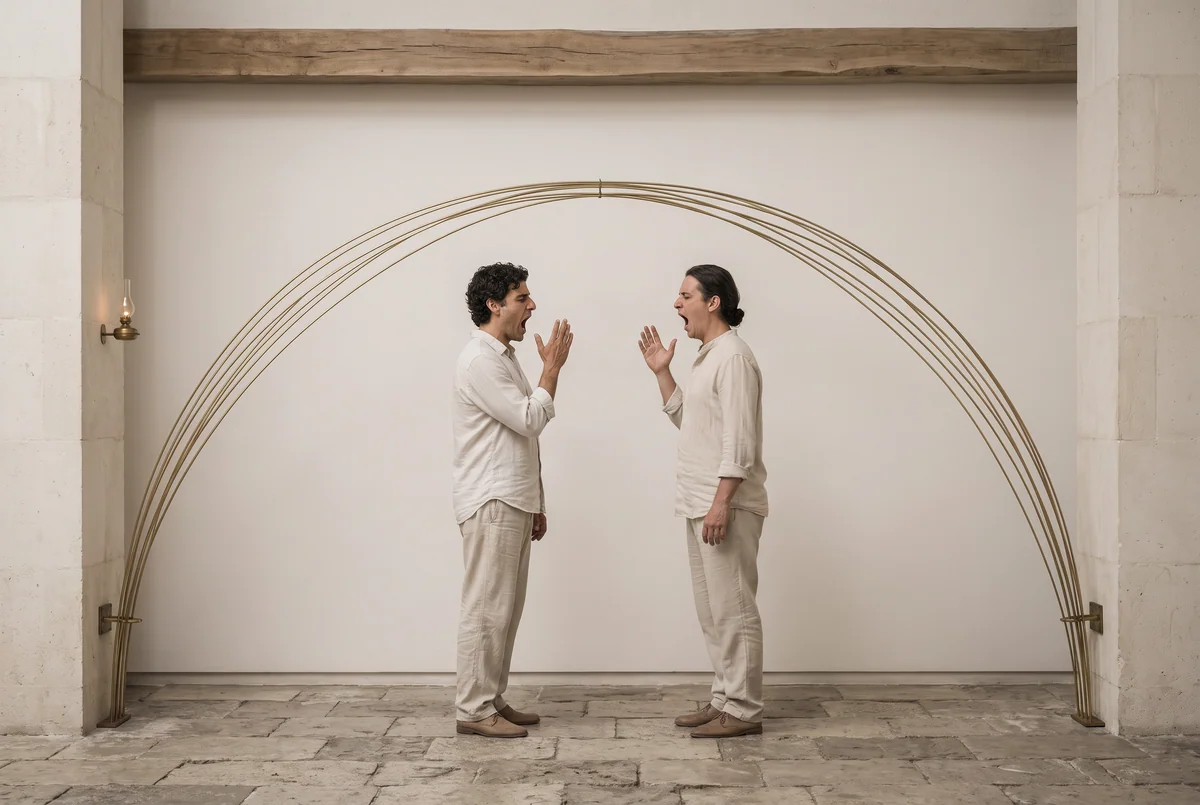
Tool · Co-regulation
Five channels through which two find a shared rhythm
Two nervous systems in the same room are forever negotiating whether to align. Usually without announcement, often without either noticing. It is called co-regulation, and it has been running since you arrived in the world.
Words are the slowest channel of all. Beneath them work quieter, older ones. Choose one and see what it does.
Choose a channel: click, or arrow keys.
Mirror neurons · co-regulation · polyvagal · educational
Mirror neurons · co-regulation
You walk into a room, and before a single word is spoken your body already knows how things stand here. Not clairvoyance but measurement: your nervous system reads the others’, in milliseconds, unasked. You were taught to call it politeness. It is research.
We have never felt alone. Buber puts it plainly: I become through the Thou. The face of the other, Levinas writes, is not a sight but a claim. And long before either of them, people knew that one person comes to rest at another’s pulse, without anyone calling it therapy.
Through what, then, do two people synchronise most strongly in the body? Not the words. The quieter channels beneath them.
- 1 · Somewhere on this page you yawned. Reflex, not boredom, I hope.